Kakadu Parrot of Mason Porcelain

Kakadu Parrot of Mason Porcelain

John Joachim Candler (Johann Joachim Kaendler) was one of the most famous porcelain sculptors of the first half of the 18th century, who designed many exquisite porcelain works for the Mason Porcelain Factory. Kakadu parrot is one of his masterpieces. This porcelain sculpture shows a lifelike Kakadu parrot sitting on a tree stump decorated with flowers and leaves. The sculpture uses multi-color painting technology to make the parrot's feathers and details on the stump more vivid. Mason Porcelain Factory was one of the first manufacturers of hard porcelain in Europe, founded in 1710.
18th Century European Porcelain Ceramic Guanyin Statues

18th Century European Porcelain Ceramic Guanyin Statues

This ceramic Guanyin statue was made by Johann Gregorius Höroldt, a German painter and porcelain painter. Holdert is known for his Chinese style decoration (Chinoiserie) designs.
18th Century European Porcelain Guanyin Statues

18th Century European Porcelain Guanyin Statues

This Guanyin image is one of the early works of the Mason Porcelain Factory and is based on a Chinese prototype. The porcelain was made by Johann Gregorius Höroldt, a German painter and porcelain painter. Holdert is known for his Chinese style decoration (Chinoiserie) designs.
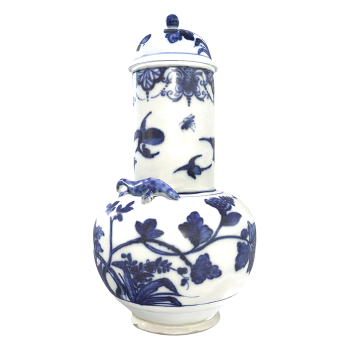
Eighteenth Century European Porcelain Mason Porcelain Blue and White Porcelain Vase

Eighteenth Century European Porcelain Mason Porcelain Blue and White Porcelain Vase

This vase is one of the representative works of Mason porcelain. Mason Porcelain Factory was one of the first manufacturers of hard porcelain in Europe, founded in Germany in 1710. This vase was made between 1722 and 1723 and was decorated with blue and white. Blue and white decoration is a method of drawing a pattern with blue pigment on porcelain and then firing it under the glaze.
18th Century European Porcelain Chinese Style Fine Neck Vase

18th Century European Porcelain Chinese Style Fine Neck Vase

This thin-necked vase of Mason porcelain was made by Mason porcelain factory in 1721. Mason Porcelain Factory is one of the earliest hard porcelain factories in Europe, established in 1710. Mason porcelain is famous for its exquisite craftsmanship and unique design, especially its blue and white underglaze decoration. The porcelain was made by Johann Gregorius Höroldt, a German painter and porcelain painter. Holdert is known for his Chinese style decoration (Chinoiserie) designs.
Qing Dynasty Yongzheng Cultural Relics Hollow Golden Overglaze Color Porcelain Bowl

Qing Dynasty Yongzheng Cultural Relics Hollow Golden Overglaze Color Porcelain Bowl

This porcelain is an antique from the Yongzheng period of the Qing Dynasty (1723-1735) and was produced in Jingdezhen. Yongzheng period porcelain is famous for its exquisite craftsmanship and unique aesthetic style. Yongzheng period porcelain glaze color variety, including pastel, enamel, fighting color and so on. Enamel porcelain has been greatly developed in the Yongzheng period and has become a work of art integrating poetry, calligraphy, painting and printing.
Eighteenth Century European Porcelain Chinese Style Decorated Gold Plated Cup

Eighteenth Century European Porcelain Chinese Style Decorated Gold Plated Cup

The porcelain was made by Johann Gregorius Höroldt, a German painter and porcelain painter. Holdert is known for his Chinese style decoration (Chinoiserie) designs. Holdert's work includes many pieces of porcelain with Chinese decorations, such as a tea set and chocolate service made in 1725 for Victor Amadeus II, King of Sardinia. These decorative styles reflect the romanticized fantasy of the East in Europe in the 18th century.
Fourth Century Artifacts Colombia Philandia Gold Urn

Fourth Century Artifacts Colombia Philandia Gold Urn

This gold urn is made of lost wax casting, polishing, welding and embossing. From the archaeological site of La Soleda in Fillandia, Colombia, belonging to the Kimba culture (4th-5th century AD). It is currently housed in the Museum of America in Madrid, Spain.
Fifth Century BC Cultural Relics Wine Glass-shaped Klatt Wine Vapor

Fifth Century BC Cultural Relics Wine Glass-shaped Klatt Wine Vapor

Glass-shaped Kratt wine ware decorated with red figures, Sicily La Gusa. Front: The warrior bids farewell to his family (wife and son in the arms of a nanny); Back: The man, armed with a stick and Himatian, stands between two women. From the site of Kamarina, Lagusa Province, Sicily, Italy. Classical period, 5th century BC. Collected in the Parco Archeologico di Kamarina e Cava d'Ispica Archaeological Park.
Tenth Century Cultural Relics Bifurcation Spiral Figure Porcelain Bowl

Tenth Century Cultural Relics Bifurcation Spiral Figure Porcelain Bowl

Bowl decorated with geometric patterns (swastika and double-forked spiral pattern "yc"). From the site of Elcano, Corclé, Panama, 900-1020 AD. In the collection of the Fundaci Foundation (El Caño). Centre for Archaeological Studies of the Isthmus (Centro de Investigaciones Arqueol ógicas del Istmo).
Wauchelvik Cup

Wauchelvik Cup

Wauchervik Cup, in the collection of the National Museum in Krakow. The Wauchervik Cup is a ceramic work of art with rich decoration and craftsmanship.
Eighteenth Century Artifacts Meissen Botegau Flute Vase

Eighteenth Century Artifacts Meissen Botegau Flute Vase

This is a vase for Botegtau flute, made in Meissen, Germany, from about 1710 to 1719. The material is a bortegtao (Bö ttgersteinzeug) with relief decoration (the so-called "Irminger relief decoration"). The flute vase used a special porcelain material known for its hardness and durability.
18th Century Artifacts Meissen Porcelain Flute Vase

18th Century Artifacts Meissen Porcelain Flute Vase

This is a flute vase, decorated with the figure part designed by Johann Gregorius Höroldt and the flower part designed by Johann Ehrenfried Stadler, made in Meissen, Germany, on August 17, 1726. The material is porcelain, and the decoration uses sprayed underglaze blue background (gespritzter Fond), overglaze color and gold.
Qin Dynasty Cultural Relics Sword-holding Terracotta Warriors and Horses

Qin Dynasty Cultural Relics Sword-holding Terracotta Warriors and Horses

The Terracotta Warriors and Horses sculpture depicts the army of Qin Shihuang, the first emperor of China. It is a martyrdom art, buried with the emperor in 210-209 BC, with the aim of protecting Qin Shi Huang in the afterlife.
Eighteenth Century Cultural Relics German Meissen Chinese Lantern

Eighteenth Century Cultural Relics German Meissen Chinese Lantern

This is a lantern, decorated by Johann Ehrenfried Stadler (Johann Ehrenfried Stadler), produced in Meissen, Germany, about 1726/1727. This lantern is decorated with Chinese style pattern (Chinoiseriedekor). Meissen porcelain is famous for its exquisite craftsmanship and exquisite decoration. The lantern was decorated with overglazed colors, demonstrating the European passion and imitation of the Chinese artistic style of the time.
Seventeenth-century relics have field underglaze blue and blue flower vase

Seventeenth-century relics have field underglaze blue and blue flower vase

This Japanese vase, which was produced in Yoda, was from about 1670 to 1690. The material is porcelain, and the decoration uses underglaze blue and white blue. This covered vase uses the decoration process of underglaze blue and white blue, which means that before firing, a pattern is drawn with blue and white blue on the surface of the porcelain, and then fired at a high temperature to allow the color to penetrate under the glaze.
Eighteenth-century relics have field underglaze color vase

Eighteenth-century relics have field underglaze color vase

This Japanese vase, produced in Yoda, was from 1700 to 1720. The material is porcelain, and the decoration uses underglaze blue and white blue, overglaze color and gold. This covered vase is in the Imari Style.
Bessamin Box

Bessamin Box

The Besamin box [Hebrew: bassamim,psumin-byksy] is a container for spices. It is used at the end of the Sabbath and is usually tower-shaped. Interestingly, the Bessamin box from Novi Songe is fish-shaped. The fish head is connected to the fish body by a hinge and can be opened and tilted to one side. The body of the fish consists of five overlapping segments, each tapering towards the caudal fin, each segment ending in semicircular scales, each with a network of textures and grooves. The various segments of the fish body are connected to each other so that the fish's body can be slightly curved.
Jingde glazed painted carp fish tank during the Kangxi period of the Qing Dynasty

Jingde glazed painted carp fish tank during the Kangxi period of the Qing Dynasty

This fish tank is from Jingdezhen, China, and was made during the Kangxi period of the Qing Dynasty (1700-1720). It features glazed painting and gold decoration, showing the exquisite craftsmanship of Jingdezhen porcelain at that time. The fish tank is decorated with plants and carp patterns, implying auspiciousness and prosperity, and is a common symbol in traditional Chinese culture.
Japanese Edo Period Pictographic Porcelain

Japanese Edo Period Pictographic Porcelain

This pictographic porcelain was made during the Edo period of Japan (1680-1700) in the Yoda area. It uses the glaze painting technique of Shijiuweimen style, showing the superb craftsmanship of Japanese porcelain making at that time. The Shikakuweimen style is known for its bright colors and fine paintings, usually decorated in red, blue, green, yellow and other colors.
19th century Qing Dynasty cultural relic porcelain gold-plated vase

19th century Qing Dynasty cultural relic porcelain gold-plated vase

This vase dates back to the 19th century. It is embedded in a gold-plated metal frame with dragon-shaped handles and feet with ear-shaped decorations.
Jingde Cylindrical Porcelain Vase in Qing Dynasty

Jingde Cylindrical Porcelain Vase in Qing Dynasty

This cylindrical porcelain vase was made in Jingdezhen, China, 1710-1715, decorated with overglaze and gold colors (famille verte). The exhibit is numbered PO 6257 and is in the porcelain collection of the Dresden State Art Collection.
Qing Dynasty Period Riverview Jingde Porcelain Lantern

Qing Dynasty Period Riverview Jingde Porcelain Lantern

This is a Chinese Qing Dynasty lantern decorated with river landscape. Made in Jingdezhen, China, early 18th century. The material is porcelain, with overglaze painting (famille verte) and gold color decoration. This exhibit is numbered PO 3318 and is in the porcelain collection of the Dresden State Art Collection.
Medieval period medicine pot in Europe

Medieval period medicine pot in Europe

It is a medicine jar (Albarello) used to hold wax ointments. The canister is in the collection of the Medical Museum of the Jaguellón University School of Medicine in Krakow. A medicine pot (Albarello) is a hollow ceramic vessel commonly used to store medicines, especially in medieval Europe. They are usually beautifully decorated with a variety of painted patterns. The design of this jar makes it easy to take out the ointment from above, while preventing the medicine from getting damp and deteriorating.